Neurodevelopmental conditions like autism spectrum disorder (ASD) and attention-deficit/hyperactivity disorder (ADHD) are often treated as discrete categories. Clinically, categories help with communication and access to supports. Biologically, however, they compress a messy reality: high variability within diagnoses, substantial overlap between diagnoses, and strong dependence on context (sleep, stress, sensory load, novelty, safety). A more mechanistic framing is to treat ASD/ADHD/AuDHD as recognizable clusters within a shared regulation space—a continuous landscape describing how nervous systems allocate attention, stabilize arousal, handle uncertainty, and recover from load.
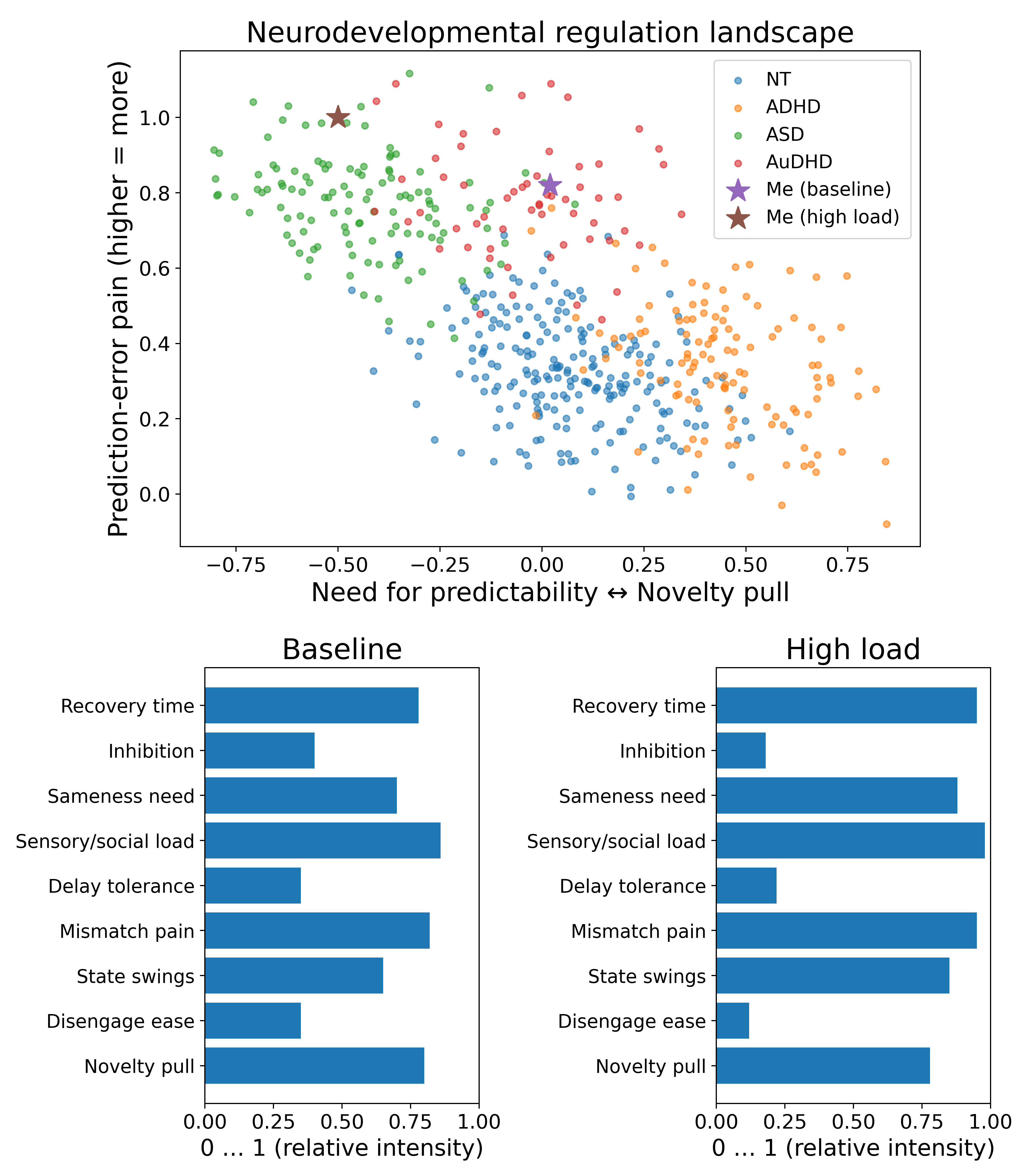
Neurotype Atlas (conceptual). This picture is a simple map of how a nervous system steers itself. Left-to-right is Need for predictability ↔ Novelty pull. Bottom-to-top is how much “surprise” hurts (Prediction-error pain). The two stars are my illustrative positions: Baseline vs High load—when sensory/social overwhelm makes me clamp down, narrow inputs, and reach for sameness. The bar charts underneath show what that looks like across multiple traits (how strongly novelty grabs me, how hard it is to disengage, how swingy arousal gets, how draining people/noise are, and how long recovery takes). Not a diagnosis—just a way to make the pattern visible.
The goal of a “regulation landscape” is not to erase categories, but to explain why they blur. In this view, diagnostic labels are practical names for density regions in a larger space: stable, recurring configurations that arise from developmental biology interacting with environment over time. The landscape approach naturally accommodates co-occurrence, partial presentations, and state-dependent shifts (e.g., “I look ADHD in ideas, autistic in sensory/social”). It also allows us to talk about what is often the core lived experience: cost—how expensive it is to stay regulated in a world that does not match your priors.
1) Why a “landscape” instead of boxes
Traditional diagnosis asks: “Which label fits best?” A landscape asks: “What regulation problem is this system solving, and what does it cost?” That re-centers the model on mechanisms rather than moralized interpretations of behavior.
In a landscape model, two things matter:
(a) Trait: relatively stable parameters—how a nervous system tends to allocate attention, weight prediction errors, and recover after load.
(b) State: moment-to-moment operating conditions—sleep debt, stress hormones, sensory/social exposure, safety cues, illness, novelty availability, and meaningfully: whether the environment is “tuned” or hostile to your nervous system.
A category model tends to flatten state into “symptom severity.” A landscape model treats state shifts as movement within the same system: the same person can look very different depending on load, while the underlying constraints remain consistent.
2) The horizontal axis: Need for predictability ↔ Novelty pull
One core dimension of regulation is the tradeoff between stabilization and exploration.
Need for predictability (leftward) reflects a strategy of minimizing variability: narrowing inputs, controlling context, reducing surprise, and preferring known patterns. This can manifest as routine, sameness seeking, reduced tolerance for ambiguous social dynamics, or strong preference for stable sensory conditions.
Novelty pull (rightward) reflects a strategy of exploration: salience-driven attention, rapid ignition toward new stimuli, and an interest-based reward structure that can outcompete low-salience obligations. This can manifest as fast associative thought, task-switching, “idea hopping,” and difficulty sustaining low-reward tasks even when the goal is valued.
Importantly, this axis is not “autism vs ADHD.” It is a general control tradeoff that can be expressed through different mechanisms:
• Reinforcement learning dynamics (what gets rewarded)
• Attentional capture and release (what grabs you; how hard it is to disengage)
• Neuromodulatory tone (salience/interest and arousal shaping what becomes “sticky”)
Many AuDHD presentations can look like a hybrid: strong novelty ignition inside a system that also needs high predictability externally—producing “deep spirals” (novelty within a constrained tunnel) rather than shallow bouncing across surfaces.
3) The vertical axis: Prediction-error pain (higher = more)
The second core dimension is the cost of mismatch—how expensive it is when the world deviates from your nervous system’s expectations.
“Prediction-error pain” is a plain-language way of describing a convergent phenomenon: surprise, ambiguity, sensory saturation, and unstable social cues can impose disproportionate physiological and cognitive cost. In practice, this can show up as faster overload, difficulty filtering background input, heightened stress reactivity, shutdown/meltdown risk, irritability, or extended recovery time.
This axis is particularly useful because it explains an everyday paradox: high capability in a controlled environment and severe impairment in a noisy one. The issue is often not skill absence; it is cost explosion.
Contributing mechanisms can include:
• sensory gating / filtering differences (how much raw input must be processed)
• arousal responsivity (how hard the system swings when perturbed)
• social uncertainty load (humans are high-entropy stimuli)
• recovery kinetics (how quickly you return to baseline once thresholds are crossed)
4) Clusters still appear—and that’s the point
If you sample many people in this space, you do not get a uniform cloud. You get density regions—clusters—because biology and development produce recurring configurations.
In a simplified description:
• ASD-leaning clusters often sit higher on mismatch cost and drift toward predictability strategies (especially under load).
• ADHD-leaning clusters often sit higher on novelty pull and show rapid ignition toward salience (especially when under-stimulated).
• AuDHD clusters often show both strong novelty ignition and high mismatch cost, creating push–pull dynamics: intense internal drive plus strong external load sensitivity.
This framework explains why category boundaries blur: the mechanisms are not mutually exclusive, and the same system can express different faces depending on context.
5) Trait vs state: why the “star” can move
A key benefit of a landscape model is that it treats dysregulation shifts as predictable, mechanical changes rather than narrative failures.
Under increasing load (sleep loss, prolonged social exposure, sensory saturation, stress), many systems move:
• up (higher prediction-error pain: more cost per mismatch), and often
• left (more clampdown: stronger need for predictability to prevent further error accumulation).
In other words: the same person can shift from exploratory/idea-driven modes to a narrowed, sameness-seeking mode because the system is protecting itself against rising mismatch cost. The model makes this legible without moralizing it.
6) Why a profile card matters
A 2-D map is a compression. Different combinations of traits can land in similar regions (and similar behaviors can arise from different mechanisms). A profile card “decompresses” the map into interpretable dimensions such as:
• Novelty pull
• Disengage ease
• State swings
• Mismatch pain
• Delay tolerance
• Sensory/social load
• Sameness need
• Inhibition
• Recovery time
This makes the framework scientifically honest: the map is a summary; the profile is the underlying shape.
7) What this framing is good for
As a communication tool, a regulation landscape shifts the conversation from “What label are you?” to “What inputs raise your cost curve, what strategies reduce it, and what recovery does your system require?”
It supports:
• mechanistic hypotheses (attention dynamics, salience systems, gating, arousal regulation)
• individualized prediction (what pushes you toward overload; what returns you to baseline)
• demystification without flattening (clusters remain real, boundaries remain fuzzy)
The central claim is simple: ASD/ADHD/AuDHD can be treated as recognizable regions in a shared neurodevelopmental regulation landscape, where both trait and state determine the lived phenotype. Visualizing that landscape helps preserve the reality of difference while refusing the myth that categories are clean biological boxes.
 Mind Stuffing