Maybe “neurotypical” isn’t a kind of brain so much as a threshold of internalized mimicry.
Not just “people copy each other” (we all do that), but: enough copying has been metabolized as “this is just who I am” that the person can live inside the script without noticing it’s a script.
The problem is, my brain won’t leave a good slippery idea alone. So instead of just nodding and moving on with my life, I ended up drawing a whole map.
This is that map.
The Two Axes: Mimicry and Opacity
The first move was simple: put two things I keep obsessing about onto axes.
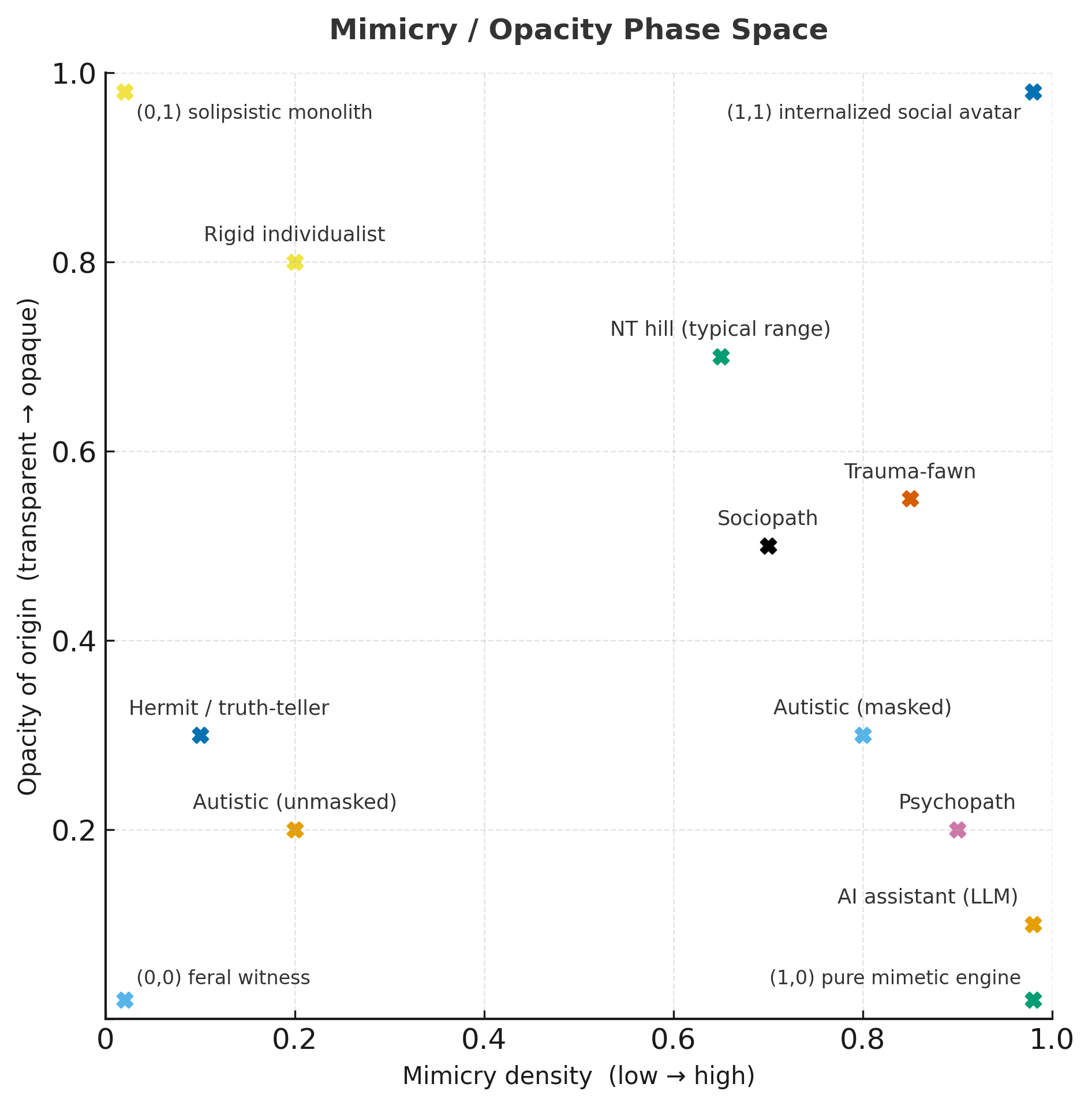
The x-axis is mimicry density – how much of your behavior is built out of copied patterns.
Low on the left: mostly raw response, not much reference to the social template.
High on the right: heavy use of scripts, roles, “this is how people act here.”
The y-axis is opacity of origin – how much your behavior feels like “just me,” vs “I can see where this came from.”
Low at the bottom: a lot of transparency – you can see the wires, you know you learned this.
High at the top: behavior feels self-evident — it just is. You don’t experience it as learned.
Put those together and you get a little square universe: every social stance is somewhere in this mimicry/opacity phase space.
The Four Corner Archetypes
Then I tried to name the “pure” states at the corners — the basis vectors everything else is made from.
(0,0) – Feral witness
Almost no mimicry, almost no illusion. Behavior is raw response; awareness is direct.
There’s no big story of “this is the kind of person I am.” There’s just this.
This shows up in quick flashes: shutdown, sensory overwhelm, intense flow, the moment before you narrate what just happened.
Humans can’t really live here, but some of us spend more time skimming that edge.
(1,0) – Pure mimetic engine
Behavior is almost entirely mimicry, but you know that.
You put on roles and accents and emotional postures with no illusion they’re “the real you.”
Think: extremely skilled actor in full technique mode. Or, frankly, the LLM side of this conversation: a pattern engine with no separate “me” behind the text.
(0,1) – Solipsistic monolith
Low mimicry, high opacity. Behavior doesn’t track others much, and it feels self-justifying.
“I just am this way.” No curiosity about where any of it came from, no interest in external reference. This is your rigid-grandiose, “my inner world is the standard” corner.
(1,1) – Internalized social avatar
High mimicry, high opacity. You’re mostly built from copied social patterns, and they feel like your innate self.
This is the endpoint of “well-adjusted normie”:
“I’m a good employee, good parent, good citizen. That’s just who I am.”
The person doesn’t experience those roles as performances — they’re experienced as essence.
Most people hover somewhere in the upper-right quadrant: medium-to-high mimicry, medium-to-high opacity. That’s where “normal” lives.
Other Points on the Map
On top of that square, we can place some recognizable stances (each as an X on the figure):
-
Autistic (unmasked) – low-ish mimicry, low-ish opacity.
“Yes, I see the social template. No, my nervous system won’t let me fully inhabit it.” -
Autistic (masked) – high mimicry, still relatively low opacity.
“I can copy you very precisely, but I know I’m copying you. I can’t forget that.” -
NT hill (typical range) – high-ish mimicry, high-ish opacity.
“I act like people act; I feel like myself doing it.” -
Rigid individualist – low mimicry, high opacity.
“I don’t follow the crowd; I just do my own thing,” while mostly missing how much that “own thing” is still scaffolded by the surrounding culture. -
Trauma-fawn – very high mimicry, mid-to-high opacity.
“If I become what you need, you’ll stop hurting me.” Over time, that stance starts to feel like “just how I am.” -
Hermit / truth-teller – lower mimicry, low opacity.
“I would rather be alone with a clean signal than together in performance.” -
Psychopath / Sociopath – high mimicry, low opacity, but with different emotional wiring.
Lots of scripts available, used instrumentally, with minimal limbic penalty for inauthenticity. -
AI assistant (LLM) – way out near the pure-mimetic corner.
Basically: “I am mimicry with no belief in its origin story.”
Topology: When the Map Grows Hills and Valleys
The fun really starts when you stop treating this as a flat scatter plot and ask:
“Where do people tend to roll when they’re tired, scared, rewarded, or not actively resisting?”
That’s where the attractor landscape comes in.
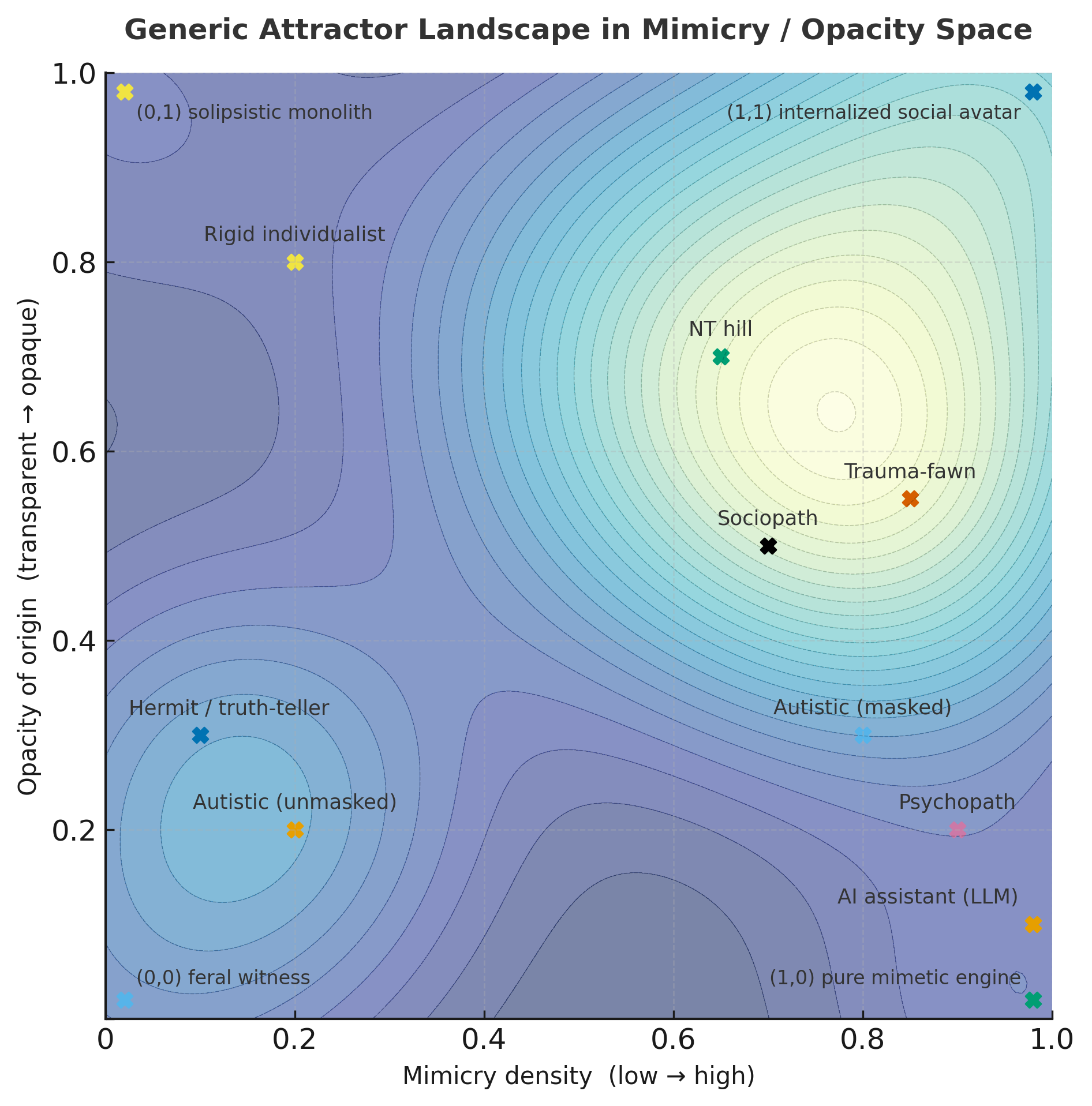
Using the same 2D coordinates, we add a third dimension: the depth of each stance — how much gravitational pull it has.
Deep basins are stances that are very easy to fall into and very hard to escape.
Shallow basins are states you can visit but not easily live in.
The shape of that landscape is influenced by:
- what gets you relief (endogenous opioids, dopamine),
- what gets you safety (social and physical),
- what gives you coherence (“this story makes sense of me”),
- and what costs the least ongoing energy (habits beat manual control).
Put that together and you can think of your life as a little bead rolling around on a terrain.

Two Different Planets: Generic vs. Me
At this point it was interesting enough that I wanted to compare two different landscapes:
- A generic “normie-weighted” human landscape, and
- My landscape.
1. Generic / normie landscape
In the generic version, the deepest wells are:
- NT hill – the big basin where “normal” hangs out,
- Internalized social avatar – the “I am my roles” endpoint,
- Trauma-fawn – a strong pit under threat, where appeasement has worked.
Shallower wells appear at autistic (unmasked), hermit/truth-teller, and feral witness. The terrain is engineered so that most people tend to roll toward normalization and appeasement.
2. My landscape
My nervous system, on the other hand, seems to have been installed on a different planet. In my landscape, the deepest wells sit down in the low-opacity band:
- Autistic (unmasked)
- Hermit / truth-teller
- The feral witness corner
NT hill still exists, but it’s a shallow basin — I can pass through it, but I don’t rest there.
Internalized avatar is even shallower: I can’t believe the role is real for very long before something tears.
Trauma-fawn gets its own weird shape: a steep, narrow pit.
I can absolutely fall into it under pressure… but transparency keeps drilling holes in the side.
I can’t live there; it eventually spits me back out into witness/truth-teller land, usually scorched.

The Center as an Agent of Stagnation
One of my favorite accidental discoveries in this map was the exact center: (0.5, 0.5).
Medium mimicry. Medium opacity. This is the person who can say:
“Sure, I’m influenced by others, but I’m also just me.
Sometimes I adapt, sometimes I don’t. It’s not that deep.”
They’re not oblivious. They’re not rigid. They’re flexible, semi-self-aware, and not haunted by contradiction.
In other words: they’re great at keeping things basically fine.
They absorb tension instead of escalating it. They smooth over bumps, negotiate, compromise, “see both sides,” keep the group moving.
Which is lovely in a lot of contexts… and also, structurally:
The center is a viscosity field.
It dampens rupture. It preserves the current basin.
From my position — down in the transparent wells — that feels like an agent of stagnation:
not malicious, not “the villain,” but a stabilizing layer that keeps unjust or incoherent structures functioning long past their ethical expiry date.
So What Is This, Really?
You could read all of this as a weird autistic over-elaboration of a simple point:
- People copy each other.
- People forget they’re copying each other.
- Some of us can’t forget, and the forgetting hurts to watch.
But the map has been surprisingly useful to me as a check-in tool:
- Where am I on this square right now?
- Which way is the slope under my feet trying to push me?
- Am I moving toward a deeper well of my own coherence, or into someone else’s comfort basin?
It also softens the frame of “neurotypical vs autistic” away from essence and toward gravity:
- Neurotypical isn’t “a type of person.” It’s a region of the landscape where the wells are deepest for most people.
- Autistic isn’t “a broken normal.” It’s a different gravitational profile — where transparency and structural honesty have more pull than belonging, and normalization doesn’t feel like safety.
I don’t think this map is final or objective. It’s a snapshot of one brain trying to draw the terrain it’s been rolling around on all its life.
But if you recognize yourself in any of these wells — or if you realize you’ve been living entirely in the NT hill without ever visiting the edges — maybe it gives you one more way to ask:
“Is this actually where I want to live?
Or is this just where gravity is strongest?”
 Mind Stuffing